

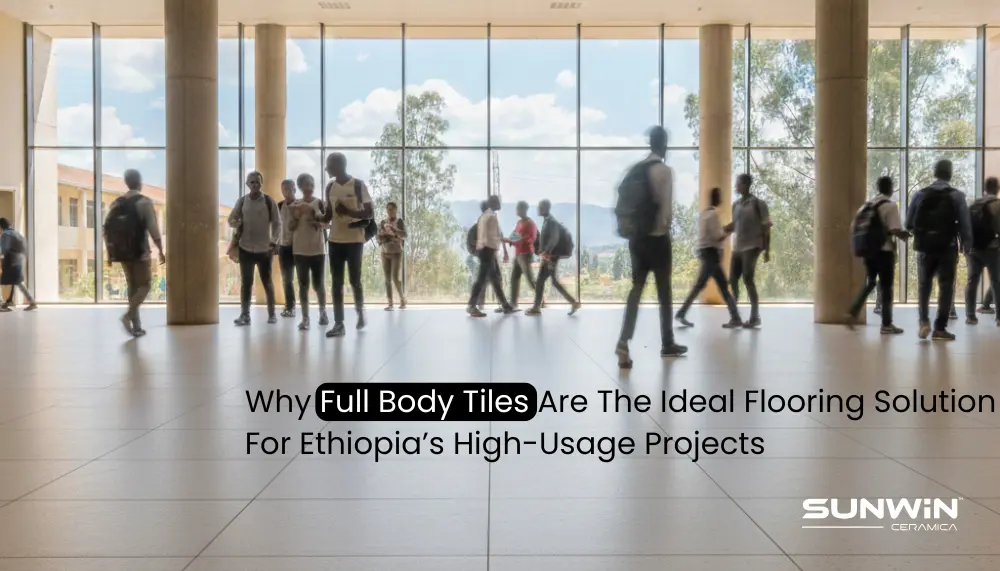
Ethiopia’s construction landscape is evolving rapidly.
Large commercial buildings, mixed-use developments, hotels, hospitals, and transport-linked infrastructure are no longer exceptions. They are becoming standard.
In such projects, flooring is not a design decision.
It is a performance decision.
When a floor fails, it does not fail visually first. It fails structurally. Abrasion increases. Surface clarity reduces. Maintenance costs rise. This is why full body tiles are increasingly specified for high-usage projects across Ethiopia.
Understanding Full Body Tile Construction
Full body tiles are manufactured so that the body composition, colour, and surface layer are homogeneous throughout the tile thickness.
From a materials engineering perspective, this means:
- No surface coating dependency
- No visual layer separation
- Uniform wear characteristics
In practical Amharic terms, contractors describe this as: “ታይ የሆነው ቀለም እስከ ታች ይቀጥላል”
This construction is critical in environments where abrasion is unavoidable.
Flooring Failure Patterns In Ethiopian High-Traffic Buildings
Across Ethiopian commercial and institutional projects, flooring degradation usually follows a predictable pattern.
Common Observed Issues
- Surface polish loss within 12–24 months
- Colour exposure at edges and joints
- Visible wear paths in corridors
- Increased cleaning frequency without visual improvement
These issues are not climate-specific alone. They are material-structure related.
Tiles with surface-only designs show differential wear, which accelerates visual aging.
Why Full Body Tiles Perform Better Under Load And Abrasion
Uniform Wear Behaviour
Because full body tiles do not rely on a decorative surface layer, abrasion does not change their appearance.
This is particularly important in:
- Airport terminals/የአየር ማረፊያ ተርሚናሎች
- Shopping malls/ የግብይት ማዕከላት
- Government buildings/የመንግስት ሕንፃዎች
- Universities/ዩኒቨርሲቲዎች
In Ethiopian usage terms: “እግር መንገድ ቢበዛም ቀለሙ አይቀየርም”
Higher Density And Structural Stability
Full body tiles are typically fired at higher temperatures and have denser internal composition.
This improves:
- Load-bearing capacity
- Resistance to micro-cracks
- Edge integrity under movement
In facilities where carts, beds, or equipment are moved daily, this structural density matters more than surface shine.
Predictable Aging Over Long-Term Use
One of the biggest operational challenges in commercial buildings is uneven floor aging.
- Full body tiles age uniformly.
- There are no isolated dull zones.
- No exposed base colour.
This consistency reduces renovation pressure, especially in hospitality and healthcare environments where shutdowns are costly.
Suitability For Ethiopia’s Maintenance Conditions
Maintenance practices in Ethiopia often involve:
- Frequent wet mopping
- Detergent-based cleaning
- Dust ingress from outdoors
Full body tiles respond well because:
- Colour depth is not surface-dependent
- Minor surface abrasion does not affect aesthetics
- Cleaning does not accelerate visible degradation
For facility teams, this means lower lifecycle maintenance effort, not just easier daily cleaning.
Where Full Body Tiles Make Technical Sense In Ethiopia
These tiles are best specified for:
- Commercial office floors
- Hotels and conference facilities
- Hospitals and clinics
- Educational institutions
- Public corridors and staircases
In residential projects with high occupancy, they also offer durability without increasing maintenance complexity.
Builders often summarise this choice simply: “አንድ ጊዜ ተጭኖ ረጅም ጊዜ ይቆያል”
Cost Evaluation From A Project Lifecycle Perspective
Initial tile pricing does not reflect total project cost.
A more accurate evaluation considers:
- Replacement cycles
- Visual degradation timelines
- Operational disruption costs
Full body tiles reduce the probability of early replacement due to appearance-related complaints.
For long-term commercial assets, this improves overall return on investment.
Importance Of Export-Oriented Manufacturing Standards
Tiles produced for export markets must comply with stricter performance controls.
Export-grade production focuses on:
- Dimensional accuracy
- Batch-to-batch colour consistency
- Controlled firing cycles
- Repeatable quality across volumes
For Ethiopian projects that rely on phased construction or repeat orders, this consistency becomes essential.
Why Sunwin Ceramica
Sunwin Ceramica operates with a strong export-focused manufacturing model. Our full body tile production aligns with international quality standards required across multiple global markets.
Export-oriented operations demand:
- Stable material composition
- Controlled shade uniformity
- Reliable long-term supply
- 20+ years of industry experience
- Innovative manufacturing process that strictly adheres to international standards
- Export to 25+ countries
Partner With India’s No.1 Tile Manufacturer
Full body tiles deliver structural consistency and long-term visual stability. For builders, architects, and designers who are looking to build awe-inspiring projects, Sunwin Ceramica provides the industry's best full body tiles. Contact us to get a quote.
FAQs
Are Full Body Tiles Suitable For Heavy-Usage Buildings In Ethiopia?
Yes. They are designed to handle continuous foot traffic, frequent cleaning, and long-term use without surface failure.
Are Full Body Tiles Good For Hospitals And Hotels?
Yes. Their structural stability and uniform aging make them suitable for environments with strict hygiene and appearance requirements.
How Do Full Body Tiles Perform Over Time?
They maintain visual consistency and structural integrity over extended periods when installed correctly.
Are Full Body Tiles Suitable For Bulk And Export Projects?
Yes. Their consistency and predictable performance make them ideal for large-scale and export-oriented developments.

Tile & Sanitaryware Manufacturer
Sunwin Ceramic is a renowned manufacturer of tiles and sanitaryware, recognized for its high-quality products & innovative designs. With a strong presence in the industry, we established ourselves as a leading brand, offering a wide range of ceramic & porcelain tiles and sanitaryware solutions.